
The Alphadecimal Library Classification System (ALiCS)
The Alphadecimal Library Classification System is a system of classifying books in a library or collection, which I have devised to catalogue my small home library. (Examples of library classification systems are Library of Congress and Dewey Decimal.) I have long struggled to find a simple system to classify my small library of books that was not too complex, had memorable main class codes and was flexible enough to handle the specific “demographics” of the books in my library. I also wanted each book’s call number to have the same number of symbols, as opposed to variable length of call numbers in other systems. I could have just used the three-digit main classes of the Dewey Decimal system, of course, but this would have meant that some classes would be too specific for subjects not present in my collection, and not specific enough for other subjects. For example, I have a large number of sports books and I wanted the classes to be specific for different sports, but using Dewey all the sports books would have been under the same class.
I also wanted a system with letters at the beginning, as I find these more memorable than a purely numerical system. I initially used the Library of Congress (LOC) system, partly because, at the time (around the late 1990s), the Library of Congress was the only place with a comprehensive online search, which was also free to use. So, all my books were classified using this system.
There were a number of problems with this system, however. For one thing, the classifications were rather lengthy for the size of the library. Also, the resulting call numbers were of varying length and it was also difficult to class books that were not present in the Library of Congress catalogue. So, I was looking for a different system, with a fixed number of say five or six characters. I decided to devise one of my own but this is not an easy task, and I have relied upon some online resources to devise my system, in particular the Free Decimal Correspondence (FDC), created by John Mark Ockerbloom, and the Melvil Decimal System (MDS) devised by the users of LibraryThing, an online resource for cataloguing personal and small libraries.
The system I have devised is called ALiCS (a play on my own name ‘Alex’), which stands for the Alphadecimal Library Classification System. The ‘Alphadecimal’ description refers to the fact the main classes are represented by two letters, and these are followed by three numbers to complete the basic classification for each book. The two letters correspond in most cases to the first two numbers in the FDC, but in some classes they refer to the first three numbers. For example, whereas ‘AR’ (Architecture) represents the FDC class ’72x’, ‘RS’ (Sports and athletics) represents the class ‘796’. This is because of the high number of sports books that I have, as mentioned above. Indeed, the “Recreation and Amusements” class, which comes under “Arts” in the FDC, has its own main class in ALiCS.
How does it work?
The ‘Call Number’ for each work is split into two parts: a. the class number and b. one or two Cutter numbers.
The class number comprises the five-digit code determined by the subject matter of the book, e.g. HE315, which is the classification of ‘History > Europe > Germany > North Eastern Germany > Brandenburg’, or GE110, which is ‘Geography > Europe > British Isles > Scotland’.
The second part of the call number comprises one or two ‘Cutter numbers’, a letter followed by one or more digits. This is a very flexible way of adding further information to the classification, requiring no lengthy special tables and is easy to devise, and consist of a single letter followed by one or more numbers. (Cutter numbers are named after Charles Ammi Cutter, who devised them as part of his Expansive Classification. See below for details of how the Cutter system works.)
Usually, the class number is followed by one Cutter number, with a dot or period in between, and the Cutter number is used to determine the “shelf position” of the work within its subject class. This usually stands for the title of the book or the author’s name. For example, the book “Scottish Place-names” by W. F. H. Nicolaisen could have the call number GE110.N5, where the Cutter number is for the author’s surname.
Sometimes, however, the first Cutter number has to be used to add further specificity to the subject matter denoted by the class number. For example, for the book ‘Faust’s Metropolis: A History of Berlin’, with the class number HE315 mentioned above, would need to be followed by the Cutter number .B4 to specify that the subject matter relates to the city of Berlin. In this case, a second Cutter number may be added, say, for the title, and so the full call number would be HE315.B4 F3. Call numbers never have more than two Cutter numbers.
Other information may be included in the call number, for example the year of publication, but this can be omitted if space is at a premium. An example in the above case would be HE315.B4 F3 1999.
Labelling
If possible the elements of a call number should be arranged vertically, as in the following example:
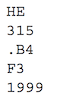
However, in my library, due to the type of labels, the printer being used and general space restrictions, the labels are arranged as below:

ALiCS Main Classes
The following list shows the main classes in the ALiCS:
| Class | Subject | FDC equiv |
| A — Arts | ||
| AA | General arts | 700—709 |
| AD | Drawing; Decoration; Design | 740—749 |
| AF | Photography | 770—779 |
| AG | Graphic arts; Engraving | 760—769 |
| AL | Landscape gardening | 710—719 |
| AM | Music | 780—789 |
| AP | Painting | 750—759 |
| AR | Architecture | 720—729 |
| AS | Sculpture | 730—739 |
| B — Literature | ||
| BA | General literature | 800—809 |
| BE | Literature of Indo-European languages of Europe | 810—889, 891 |
| BH | Literature of Indo-Iranian languages | 892 |
| BJ | Literature of Caucasian & other languages | 899 |
| BK | Literature of East Asian languages | 895 |
| BN | Literature of North American indigenous languages | 897 |
| BP | Literature of South American indigenous languages | 898 |
| BS | Literature of Afro-Asiatic languages | 893, 896 |
| BT | Literature of Turkic, Finno-Ugric & Dravidian languages | 894 |
| BV | Literature of Austro-Asiatic languages & languages of Oceania | 899 |
| BX | Literature of other languages & artificial languages | 899 |
| E — Religion | ||
| EA | General religion | 200—209 |
| EC | Christianity | 220—289 |
| EH | Religions of Indic origin | 294 |
| EJ | Judaism | 296 |
| EM | Islam & Bahá’i faith | 297 |
| ET | Natural theology | 210—218 |
| EX | Other religions & comparative religion | 290—293, 299 |
| EZ | Zoroastrianism | 295 |
| G — Geography, Voyages & Travels | ||
| GA | General geography, voyages & travels | 910 |
| GC | Geography of the ancient world | 913 |
| GE | Geography of Europe | 914 |
| GF | Geography of Africa | 916 |
| GH | Historical geography | 911 |
| GM | Maps & atlases | 912 |
| GN | Geography of North America | 917 |
| GP | Geography of South America | 918 |
| GS | Geography of Asia | 915 |
| GX | Geography of other areas | 919 |
| H — History & Biography | ||
| HA | General history & biography | 900—909 |
| HB | Biography | 920—929 |
| HC | History of the ancient world | 930—939 |
| HE | History of Europe | 940—949 |
| HF | History of Africa | 960—969 |
| HN | History of North America | 970—979 |
| HP | History of South America | 980—989 |
| HS | History of Asia | 950—959 |
| HX | History of other areas | 990—999 |
| L — Language | ||
| LA | General language | 400—409 |
| LB | Linguistics | 410—419 |
| LE | Indo-European languages of Europe | 420—489, 491 |
| LH | Indo-Iranian languages | 492 |
| LJ | Caucasian & other languages | 499 |
| LK | East Asian languages | 495 |
| LN | North American indigenous languages | 497 |
| LP | South American indigenous languages | 498 |
| LS | Afro-Asiatic (Hamito-Semitic) languages | 493, 496 |
| LT | Turkic, Finno-Ugric & Dravidian languages | 494 |
| LV | Austro-Asiatic languages & languages of Oceania | 499 |
| LX | Other languages; Artificial languages | 499 |
| N — Natural Sciences | ||
| NA | General science | 500—509 |
| NB | Botany | 580—589 |
| NC | Chemistry | 540—549 |
| NF | Physics | 530—539 |
| NG | Geology; Earth sciences | 550—559 |
| NL | Life sciences | 570—579 |
| NM | Mathematics | 510—519 |
| NP | Palaeontology | 560—569 |
| NR | Astronomy | 520—529 |
| NZ | Zoology | 590—599 |
| P — Philosophy | ||
| PA | General philosophy | 100—109 |
| PD | Ideology; Philosophical systems | 140—149 |
| PE | Ethics | 170—179 |
| PF | Modern philosophy | 190—199 |
| PH | Philosophy of humanity | 120—129 |
| PL | Logic | 160—169 |
| PM | Metaphysics | 110—119 |
| PN | Ancient, mediaeval & eastern philosophy | 180—189 |
| PP | Parapsychology | 130—139 |
| PS | Psychology | 150—159 |
| R — Recreation & Amusements | ||
| RA | Amusements | 790 |
| RC | Card games; Games of chance | 795 |
| RF | Fishing; Hunting; Shooting | 799 |
| RG | Games & indoor amusements | 793 |
| RH | Horsemanship; Animal racing | 798 |
| RK | Games of skill | 794 |
| RP | Public entertainment | 791 |
| RS | Sports & athletics | 796 |
| RT | Theatre; Dance | 792 |
| RW | Water & Aerial sports | 797 |
| S — Social Sciences | ||
| SA | General social sciences | 300—307 |
| SC | Customs & folklore | 390—399 |
| SD | Education | 370—379 |
| SE | Economics | 330—339 |
| SG | Statistics | 310—319 |
| SL | Law | 340—349 |
| SM | Public administration; Military science | 350—359 |
| SP | Political science | 320—329 |
| SS | Social service; Societies | 360—369 |
| ST | Transport; Communications; Commerce | 380—389 |
| T — Technology | ||
| TA | General technology | 600—609 |
| TB | Building | 690—699 |
| TC | Chemical technology | 660—669 |
| TE | Engineering | 620—629 |
| TF | Manufacturing | 670—679 |
| TG | Agriculture | 630—639 |
| TH | Home economics | 640—649 |
| TM | Medicine | 610—619 |
| TP | Occupations & handicraft | 680—689 |
| TX | Business | 650—659 |
| X — General Works & Information Sciences | ||
| XA | General information; Computing | 000—006 |
| XB | Bibliography | 010—017 |
| XE | Encyclopaedias | 030—039 |
| XJ | Journalism; Newspapers | 070—079 |
| XL | Library science | 020—028 |
| XP | Periodicals | 050—059 |
| XQ | Quotations; Anthologies | 080—089 |
| XR | Rare books | 090—099 |
| XS | Societies; Associations | 060—069 |
A lookup table of F.D.C. main headings to A.Li.C.S. subject codes can be downloaded here (opens in a new tab).
Version 1.1 of the full schedule of the A.Li.C.S. system is available here (opens in a new tab).
Cutter Numbers
The standard Cutter system used by the ALiCS is as follows:
1. After initial vowels:
| For the second letter: | b | d | l-m | n | p | r | s-t | u-y |
| Use number: | 2 | 3 | 4 | 5 | 6 | 7 | 8 | 9 |
2. After the initial letter ‘S’:
| For the second letter: | a | ch | e | h-i | m-p | t | u | w-z |
| Use number: | 2 | 3 | 4 | 5 | 6 | 7 | 8 | 9 |
3. After the initial letters ‘Qu’:
| For the second letter: | a | e | i | o | r | t | y |
| Use number: | 3 | 4 | 5 | 6 | 7 | 8 | 9 |
| For initial letters Qa-Qt, use: | 2-29 |
4. After other initial consonants:
| For the second letter: | a | e | i | o | r | u | y |
| Use number: | 3 | 4 | 5 | 6 | 7 | 8 | 9 |
5. For additional letters:
| For the third letter: | a-d | e-h | i-l | m-o | p-s | t-v | w-z |
| Use number: | 3 | 4 | 5 | 6 | 7 | 8 | 9 |
For numbers, use the number range ‘A12-A19’.
Other notations can also be used, e.g. ‘v.1’, ‘v.2’ for volume numbers, and ‘c.1’, ‘c.2’ for copy numbers of the same work.
ALiCS v1.1.9 © Alex Middleton, 2019.
The ALiCS system is open source and it can be used or modified for personal purposes. An acknowledgement would be appreciated, however. ALiCS is based upon and takes much of its information from the Free Decimal Correspondence by John Mark Ockerbloom, and MDS (Melvil Dewey System), an adaptation of the FDS used by members of LibraryThing to classify their books. The Dewey Decimal System is copyright of the OCLC.